How Investors Should Think About BRICS, Oil and Gold
Wednesday, Jun 24, 2026
Investing is as easy as it's ever been in terms of access. Investor exposure to stocks, ETFs, mutual funds, and thematic portfolios can be achieved with just a few taps of a smartphone. However, with all the information available that is more now than ever, there is one fundamental question that many investors still find themselves having to answer:
What is really important for long-term investment returns?
Daily headlines in the market don't have the answer. Rather, investors who have made it to the top of the game are able to grasp the bigger picture that can impact markets over years and decades. BRICS economies, oil markets and gold are among the most significant of these forces.
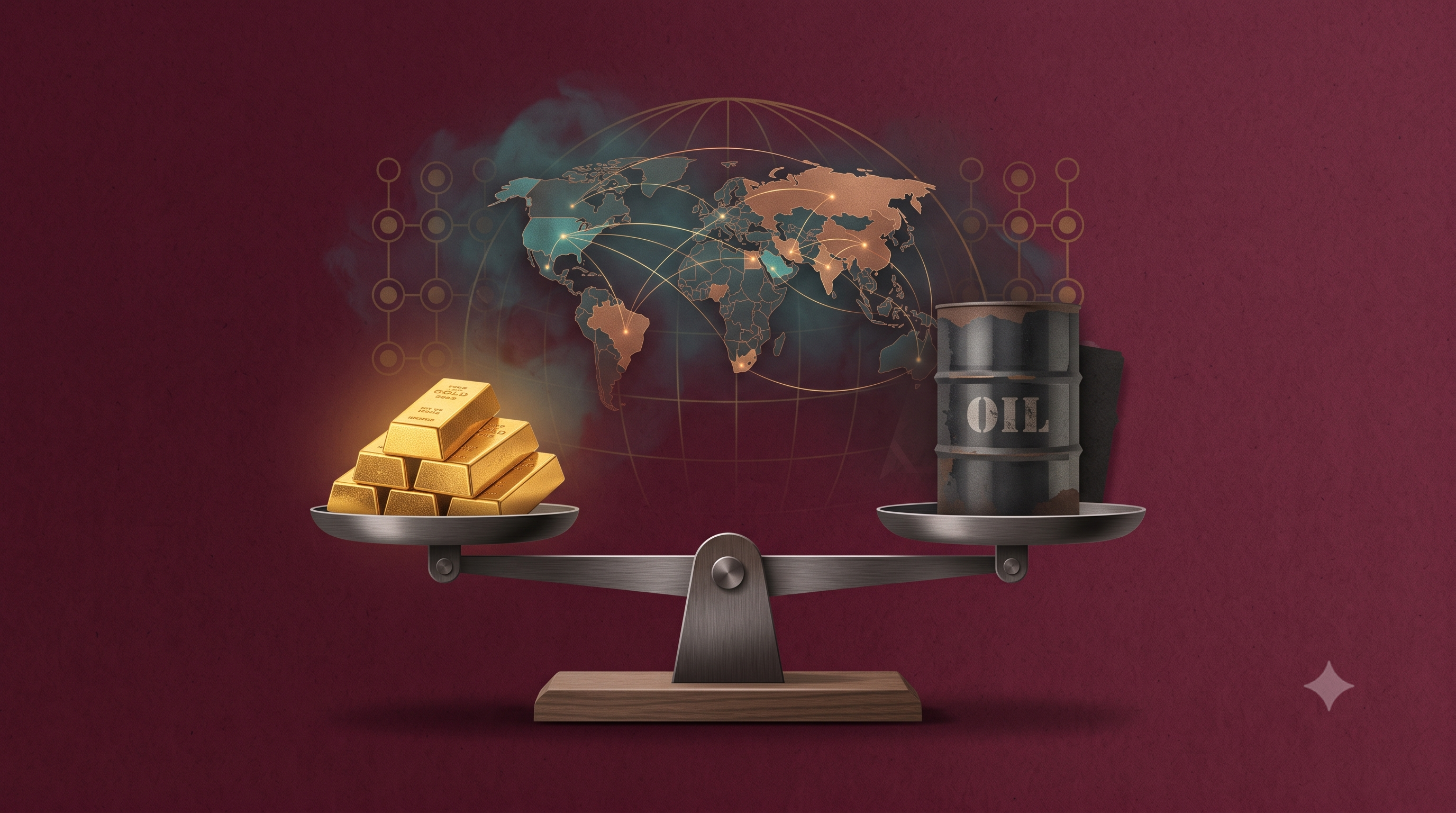
These might appear to be different subjects at first glance. One is a set of new economies, another is a product that fuels the world's industry, and the third is a natural resource that is frequently linked to security. These three forces, however, are inextricably linked and can offer us some insights as investors into the trends of the economy, inflation, risk, and portfolio construction.
The BRICS oil-gold relationship is not a prediction of what will happen next. It's about creating a framework that will aid investors in their thinking, capital allocation, and behavioral control during uncertain times.
Why BRICS Matters to Investors
The members of BRICS nations were initially Brazil, Russia, India, China, and South Africa. The grouping has developed over time to become an important economic bloc which has increasing influence in international trade, trade in commodities, manufacturing, and financial sectors.
Collectively, BRICS nations account for a large share of the world's population and economic activity. More importantly, these economies continue to play a major role in driving future global growth. For investors, BRICS represents more than a geopolitical concept. It represents long-term economic transformation.
The Growth Story behind BRICS
Several structural trends make BRICS economies important for investors:
- Growing middle-class populations
- Rising consumer spending
- Rapid urbanization
- Expanding manufacturing capabilities
- Infrastructure development
- Increasing energy consumption
Take India as an example. As incomes rise and infrastructure projects expand, demand increases across multiple sectors, including automobiles, housing, banking, technology, transportation, and energy. A similar pattern has historically occurred in other developing economies. As countries industrialize and consumption rises, demand for resources and commodities grows alongside economic output.
This is one reason investors interested in long-term trends often monitor developments within BRICS nations.
Oil: The Commodity That Powers the Global Economy
While technology and innovation receive much of the attention today, oil remains one of the most important commodities in the world.
Virtually every sector of the economy depends on energy. From transportation and logistics to manufacturing and agriculture, oil continues to influence the cost structure of businesses worldwide. As a result, oil prices often provide valuable clues about economic conditions.
Why Oil Prices Matter
Changes in oil prices can affect:
- Inflation
- Consumer spending
- Corporate profitability
- Interest rates
- Economic growth
When oil prices rise sharply, businesses typically face higher operating expenses.
For example, an airline company experiences increased fuel costs. A logistics company spends more on transportation. Manufacturers face higher production expenses. These additional costs often flow through the economy and influence prices paid by consumers.
On the other hand, lower oil prices can act as an economic stimulus by reducing costs for businesses and increasing disposable income for households.
However, context matters.
Falling oil prices are not always positive. Sometimes they indicate weakening demand and slowing global growth. This is why Green Portfolio’s investment consultants focus not only on oil prices themselves but also on the reasons behind their movement.
Understanding the BRICS Oil Gold Investment Connection
Many investors analyze economic themes individually. A more effective approach is understanding how they interact. The relationship among BRICS, oil, and gold is often viewed as a chain of economic events.
A Simplified Example
Imagine a period of strong growth across major BRICS economies.
As industrial activity increases:
- Factories produce more goods.
- Transportation demand rises.
- Energy consumption increases.
- Oil demand grows.
- Oil prices may move higher.
- Inflationary pressures emerge.
- Investors seek assets that may preserve purchasing power.
- Gold demand increases.
This sequence will not occur in exactly the same way every time, but it demonstrates how economic growth, commodities, inflation, and investment behavior can become interconnected.
Gold: More than Just a Safe-Haven Asset
Gold has fascinated investors for centuries.
Unlike companies, gold does not generate earnings.
Unlike bonds, it does not produce regular income.
Yet central banks, institutions, and individual investors continue to allocate capital to gold.
Why?
Because gold serves a unique purpose within a portfolio.
The Multiple Roles of Gold
Gold is often used as:
- A store of value
- A hedge against inflation
- A portfolio diversifier
- A defensive asset during uncertainty
One of the most common misconceptions is that gold only performs well during financial crises.
In reality, gold can benefit from a variety of conditions, including:
- Rising inflation expectations
- Currency depreciation
- Geopolitical uncertainty
- Changes in interest rate expectations
- Central bank purchasing activity
This makes gold a useful component within a broader asset-allocation strategy.
An Investor Example
Consider two investors with similar financial goals.
Investor A allocates 100% of their capital to equities.
Investor B maintains a diversified portfolio that includes equities alongside a measured allocation to gold.
During strong bull markets, Investor A may experience higher returns. However, during periods of volatility or economic uncertainty, Investor B may benefit from reduced portfolio fluctuations.
How Serious Investors Think Differently
One characteristic separates experienced investors from speculators. Speculators try to predict outcomes. Investors build systems. This distinction becomes especially important when discussing BRICS, oil, and gold.
No one consistently predicts:
- Future oil prices
- Gold price movements
- Geopolitical developments
- Economic cycles
Yet many investors spend significant energy trying to do exactly that. A more productive approach focuses on preparation rather than prediction.
Why Structure Matters More Than Market Forecasts
Many investors fail not because they lack opportunities. They fail because they lack structure.
The modern investment landscape offers endless choices:
- Stocks
- Mutual funds
- ETFs
- Commodities
- Thematic investments
While choice can be valuable, too many choices often create confusion.
Common investor challenges include:
- Analysis paralysis
- Frequent portfolio changes
- Emotional decision-making
- Chasing market trends
- Lack of clear goals
This is why successful investing often depends on a simple framework built around three principles:
1. Clarity
Know what you are trying to achieve.
2. Simplicity
Avoid unnecessary complexity.
3. Discipline
Follow a repeatable process.
These principles often contribute more to long-term wealth creation than short-term market predictions.
Using Smallcases to Participate in Long-Term Themes
Many investors understand the importance of macroeconomic trends but do not have the time required to analyze dozens of individual companies.
This is where thematic investing approaches by Green Portfolio can become useful. A smallcase investment provides exposure to a curated basket of stocks built around a specific strategy, sector, or theme.
Instead of selecting individual stocks one by one, investors can participate in broader investment ideas through a structured framework. Before choosing to invest in smallcase portfolios, investors should evaluate their risk tolerance, investment horizon, and financial objectives.
Some investors may seek growth-oriented opportunities, while others may prioritize stability and capital preservation. Similarly, understanding smallcase investment charges and portfolio methodology can help investors make more informed decisions.
Aligning Investments with Financial Milestones
One mistake many investors make is focusing entirely on products instead of outcomes.
They ask:
"What should I invest in?"
A better question is:
"What am I trying to achieve?"
This shift in thinking changes the entire investment process.
Stage 1: Building the First ₹25 Lakh
At this stage, the primary objective is consistency.
Investors need:
- Clear direction
- Disciplined SIPs
- Simplicity
- Long-term habits
Stage 2: Building Toward ₹1 Crore
As wealth grows, portfolio structure becomes increasingly important.
Investors often benefit from:
- Consolidation
- Better asset allocation
- Reduced overlap
- Goal-based planning
Stage 3: Scaling Toward ₹5 Crore and Beyond
At higher wealth levels, risk management becomes just as important as growth.
Focus areas include:
- Capital preservation
- Portfolio efficiency
- Tax awareness
- Wealth protection
This milestone-based approach by Green Portfolio helps investors avoid random decision-making and maintain focus on meaningful financial goals.
Rather than searching endlessly for the top smallcase to invest, investors can focus on selecting strategies that align with their stage of wealth creation.
Likewise, understanding the smallcase minimum investment required for different portfolios allows investors to choose options that fit their current financial capacity.
For investors exploring growth-oriented themes, evaluating a smallcase momentum strategy may also be worthwhile as part of a diversified portfolio approach.
The Final Takeaway
The relationship between BRICS, oil, and gold offers investors a powerful lens through which to understand the global economy.
BRICS economies influence growth and resource demand. Oil reflects economic activity and inflation pressures. Gold provides diversification and resilience during uncertainty.
At Green Portfolio, the approach is straightforward: investors achieve better outcomes when they follow a structured system rather than react to headlines.
Whether through thoughtfully constructed Smallcases or milestone-driven GP Roadmaps, the goal remains the same: to help investors move from uncertainty to clarity, from scattered decisions to disciplined investing, and from short-term noise to long-term wealth creation.
Frequently Asked Questions:
1. How are BRICS, oil, and gold connected from an investment perspective?
Economic growth in BRICS countries can increase energy demand, influence oil prices, and affect inflation. Rising inflation concerns often increase investor interest in gold as a diversification and risk-management asset.
2. Why should long-term investors track oil prices?
Oil prices influence inflation, corporate profitability, consumer spending, and economic growth, making them an important indicator for investors.
3. Does gold belong in a long-term investment portfolio?
Gold can provide diversification and may help reduce overall portfolio volatility during periods of economic uncertainty.
4. How can investors gain exposure to long-term market themes?
Investors can use thematic portfolios, mutual funds, or a suitable smallcase investment strategy to participate in specific sectors, trends, and investment ideas.
5. What matters more: predicting markets or following a process?
For most investors, following a disciplined investment process is far more important than attempting to predict short-term market movements.
Share this story


Ready to build wealth?
Ready to build wealth?
 Talk to an expert
Share this story



 Talk To An Expert