The Hidden Cost of Over-Diversifying Your Mutual Fund Portfolio
Friday, Mar 6, 2026
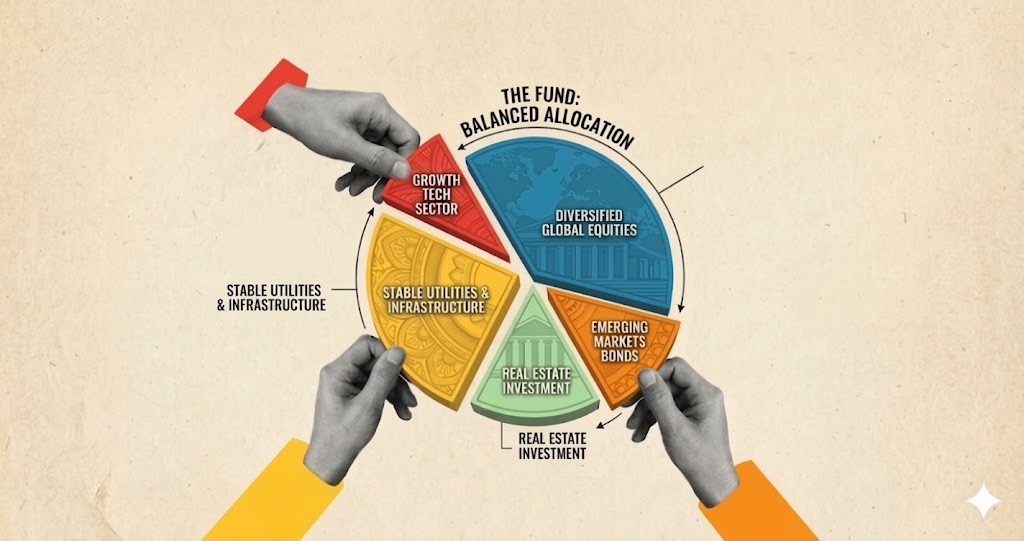
There is a point at which adding one more mutual fund stops protecting your portfolio and starts undermining it. Most investors never find that point because nobody tells them it exists.
More funds feels responsible. It feels like the cautious, sensible thing to do. But beyond a certain threshold, every new fund you add is quietly working against you.
What is over-diversification and why does it happen in mutual fund portfolios?
Over-diversification in mutual funds happens when an investor holds more funds than their portfolio has distinct roles to fill. Each additional fund beyond that point does not add a new exposure. It dilutes the impact of the exposures already there, adds cost, and increases the number of moving parts the investor has to track and emotionally manage.
It happens for the same reason portfolio sprawl does: investing is sold incrementally. Each recommendation arrives in isolation, without reference to what is already in the portfolio. Over time, the additions accumulate and the structure quietly collapses under its own weight.
Over-diversification is the point at which adding funds to a portfolio no longer reduces risk but instead dilutes return potential, increases cost drag, and raises the probability of reactive decision-making. In a mutual fund context, it typically occurs when an investor holds multiple funds within the same category, producing overlap without meaningful additional protection. The fix is not fewer investments. It is fewer funds with more intentional roles.
According to research in behavioural finance, including work by Shlomo Benartzi and Richard Thaler on naive diversification, investors systematically spread money across available options regardless of whether those options are meaningfully different. In a mutual fund context, this means holding four large-cap funds not because each serves a different purpose but because all four were available and each seemed reasonable at the time.
What does over-diversification actually cost a mutual fund investor?
The cost has three layers, and most investors only ever think about the first one.
The first layer is fees. Every fund carries an expense ratio. If you hold twelve funds with an average expense ratio of 1 percent, that is 1 percent leaving your portfolio annually across all twelve positions. A focused portfolio of five funds with the same average expense ratio costs the same percentage but with far less duplication in the underlying exposure you are paying for.
The second layer is diluted conviction. When your best-performing fund returns 18 percent in a year but it represents only 8 percent of your portfolio because you spread across twelve funds, that strong performance barely moves your overall number. Your best ideas get drowned out by your average ones. The mathematics of concentration, within reason, works in your favour. The mathematics of sprawl works against you.
The third layer is the most expensive: decision fatigue and emotional interference.
|
Number of funds held |
Annual review complexity |
Emotional noise |
Impact of one strong performer |
|
4 to 6 funds |
Low, one review covers everything |
Low, fewer data points to react to |
High, meaningful portfolio weight |
|
7 to 9 funds |
Moderate, manageable with discipline |
Moderate, more comparisons to make |
Medium, diluted by other positions |
|
10 to 12 plus funds |
High, difficult to review meaningfully |
High, more signals to misread |
Low, performance gets averaged out |
Behavioural finance research consistently shows that decision fatigue leads to worse choices. The more a portfolio demands active attention, the more likely an investor is to make reactive decisions at exactly the wrong moment. Over-diversification does not just dilute returns mathematically. It creates the conditions for the emotional exits that do the most damage.
For a deeper look at how risk and behaviour intersect in a portfolio, read Modern Risk Management for Everyday Investors.
.
Is broad diversification itself the problem?
No. This is an important distinction.
Broad diversification across asset classes, holding equity alongside debt, spreading across market caps, including international exposure where appropriate, is sound and well-supported by decades of portfolio theory. That kind of diversification reduces genuine risk by ensuring your portfolio does not move entirely in one direction.
The argument here is specifically against fund sprawl within a single asset class. Holding ten equity mutual funds is not the same as being diversified across ten different return drivers. Most diversified equity mutual funds in India already hold 40 to 80 stocks each. A single well-chosen flexi-cap fund gives you exposure to hundreds of businesses across sectors and market caps. Adding three more flexi-cap funds does not multiply that exposure. It multiplies the noise.
The question to ask about every fund in your portfolio is not "does this give me more diversification?" It is "does this give me a meaningfully different exposure to what I already have?" If the answer is no, the fund is adding complexity without adding protection.
How to Choose the Right Mutual Funds covers how to evaluate whether a fund is genuinely earning its place in your portfolio.
How do you find the right number of funds for your portfolio?
At Green Portfolio, we call this the Milestone Method. Define the target amount first, identify the risk posture that fits your horizon and milestone stage, then build the minimum number of funds needed to cover each meaningful exposure within that posture.
For the Start stage, building toward ₹25 Lakh over five to seven years, a high-growth posture needs two to three equity funds covering different market cap segments, with minimal debt exposure at this stage.
For the Build stage, building toward ₹1 Crore over seven to ten years, a balanced posture needs three to four funds covering large-cap stability, mid and small-cap growth, and a debt or balanced advantage buffer.
For the Scale stage, building toward ₹5 Crore over ten plus years, a resilience-first posture needs four to five funds with explicit protection built in as the milestone approaches.
In every stage, the fund count is a deliberate output of the milestone and posture, not a number arrived at by accumulation. That is the difference between a portfolio built with intention and one that grew by addition.
Achieving Financial Goals with Mutual Funds covers how milestone-based thinking changes the way you build and hold a portfolio over time.
What should you do if you recognise this in your own portfolio?
Start by identifying which funds in your portfolio are genuinely adding a distinct exposure and which are duplicating something already there. Then stop adding to the duplicates. Redirect new investments into your lean target structure. Let the existing positions age past the one-year mark before exiting to manage capital gains tax efficiently.
The goal is not to get to four funds by next month. The goal is to stop the sprawl from growing further today and build toward clarity over the next few review cycles.
A lean portfolio is not a concentrated bet. It is a structure where every position has a clear rationale, a defined role, and enough weight to actually matter when it performs.
Beyond a certain point, more funds is not more safety. It is more noise, more cost, and more opportunity for the kind of emotional interference that quietly breaks compounding over years.
Most investors reading this already sense that their portfolio has crossed that line. The harder part is having a structure to fix it with confidence rather than guesswork.
This is exactly the problem The Wealth Roadmap is built to solve. The lean portfolio construction at every milestone stage is a deliberate feature, not a limitation. Each fund has a role. Each role has a reason. Nothing is there because it seemed like a reasonable addition at the time. If your portfolio does not yet reflect this kind of intentional structure, that is exactly what The Wealth Roadmap is designed to fix. See how it works: The Wealth Roadmap
Disclaimer: Mutual fund investments are subject to market risks. Read all scheme-related documents carefully before investing. The information in this article is for educational purposes only and does not constitute investment advice.
Share this story


Ready to build wealth?
Ready to build wealth?
 Talk to an expert
Share this story



 Talk To An Expert